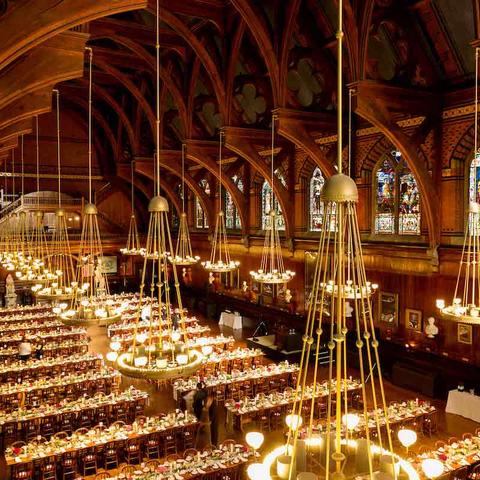
Harvard Dining Services: A Case Study
I had the opportunity to work at Harvard, and the way they did business dramatically changed the way I view business.

David Johnson
I had the opportunity to work at Harvard University Dining Services and what I learned there surprised me and taught me things that would lead to my own success.
Mike Berry
I arrived in year four of Mike Berry's five-year plan. Mike Berry was a visionary leader, the kind you hear about and aspire to meet. He had arrived a little over four years ago, had set out on a large, seemingly impossible five-year plan to transform the department from one of the worst and most criticized at the university to one of the best in the entire world. He would end up taking the job as an executive vice president of Disneyland.
Yes, But It's Harvard
I know when I talk about Harvard, people often roll their eyes because they think "Well Harvard's different. They're rich." I have to correct this assumption. I had this assumption when I arrived too. But my department was given very little to achieve their success. They didn't have deep pockets. They had to provide world class service, while on a limited budget.
Money is an Excuse
By the time I had arrived most of the transformation had already happened. Harvard was ranked as the number one food service for universities and colleges. And what was more surprising was that they did it by spending less than almost anyone else in the country. How did they do this?
They didn't achieve their success through throwing money at their problems. They thought smarter. One of the most powerful things they did was to create the thanks program.
Harvard is still Harvard, and there were countless vendors who wanted Harvard's business. And there's no easy way to put this but they essentially tried to bribe the management to use their company. They gave out TVs, tickets to the Bruins, Red Sox and Celtics, small trips, dinners, and other perks, designed to make management happy.
However, management did not accept them, instead they set them aside as gifts.
The Thanks Program
Throughout campus, Mike gave out pieces of paper. The campus dining services were spread out over miles between all the dining halls and restaurants. These papers were simple. They simply had three lines. "Thanks To: _______" Then there was a big space to write in what the thanked person did.
Anyone had the power to thank anyone else. They simply wrote down who they wanted to thank, and for what. This paper was then posted onto the local bulletin board.
Then once every few months, these papers were collected and put into a big fishbowl. And then random papers were drawn. If the paper was drawn, whoever was thanked won one of those corporate gifts.
And it was a huge success.
Easy
First it was shocking how easy it was to implement this program. It was free and easy.
Employees Felt Empowered
Employee appreciation programs are nothing new, but what was unique here was that the employees, not managers, could decide who deserves to get rewarded.
Employees Get a Voice
Often people feel they are unheard in their organization. This was an opportunity to speak and everyone would hear it.
Uncovers the Hidden
Frequently in an organization not everyone is aware of what's going on. Managers especially can be disconnected from what's happening on the ground. This system gave them a better, more honest picture of who was doing what.
Everyone Rowing the Same Direction
A challenge in any organization is that not everyone is clear on what their job is and where they are going. So sometimes people waste time doing things that they think are important but are not. This rewards people by focusing on what is valuable to the organization. Rather than criticizing, it rewards people who are doing.
Emphasizes Resource Issues
If someone is thanked, it frequently raises many questions. Like why is one person helping someone else out? Don't they have enough resources? Does someone have too much free time? Does someone not have enough? Is there a fundamental structural issue?
Simple Success
In the end, it was a simple program that was cheap and easy to implement.
I've never seen a program so successful that was so simple.
It Worked for My Company Too
I was so surprised by how successful the program was that I implemented it when I created my Internet banking company, Atrium, which is now over 25 years old and serving some of the most prestigious colleges in the world.
The Reason I Started Jasper Goose
I continued to be impressed by it and I started the company, Jasper Goose, to share it with others. I have made it free, funded by my own personal investment, because I believe in it so much. I have even used it in my own family, and it is amazing to see teenagers thanking one another and winning prizes.
David Johnson is the founder of Jasper Goose, a peer recognition platform for teams that believe good work deserves to be seen.